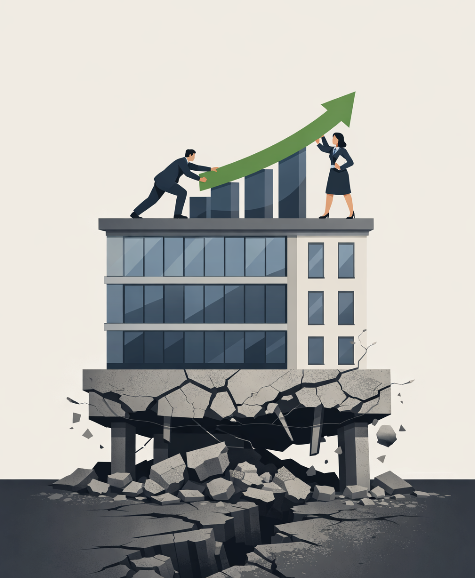
Over the years working hands-on with SaaS companies at very different stages, from early scale-ups to more mature recurring revenue businesses, I’ve seen the same pattern repeat itself with uncomfortable consistency.
When growth slows down or becomes unpredictable, the reaction is almost always the same:
hire more sales reps, push harder on marketing, change pricing, or chase the next growth channel.
What rarely happens is a pause to ask the question that actually matters:
Is our revenue designed to scale, or are we just applying more pressure to a fragile system?
In most cases, the honest answer is no.
These companies don’t suffer from a lack of effort, talent, or ambition. They suffer from something far more structural: revenue is being treated as an outcome, not as a system.
Revenue doesn’t scale by pressure. It scales by design.
One of the first mindset shifts I help leadership teams make is changing how they think about revenue altogether.
Revenue is not the result of heroic salespeople, clever campaigns, or aggressive quarterly targets. Those things can generate short-term spikes, but they rarely create predictability, and they almost never create durability.
Predictable revenue comes from architecture.
When revenue is well designed, teams don’t need to “push harder.” The system itself creates momentum. Customers move forward with less friction, onboarding accelerates time-to-value, expansion becomes natural, and forecasting stops being an exercise in hope.
When it isn’t, every quarter feels like starting from zero, regardless of how hard people work.
Funnels are lying to you
Another common trap is an unhealthy obsession with the traditional funnel. Leads go in. Deals come out. Everything is optimized around conversion at the top and closing at the bottom.
The problem is simple: the funnel ends exactly where the real work begins.
In modern SaaS, the sale is not the finish line. It’s the midpoint.
Acquisition without retention is not growth, it’s leakage. Closing deals that don’t onboard properly, don’t reach value fast, or don’t expand is simply renting revenue. The numbers might look good for a quarter or two, but the system underneath is quietly accumulating risk.
Healthy growth requires symmetry: what happens before the sale must be mirrored by what happens after it.
Most revenue issues are not people problems
This is one of the hardest truths for leadership teams to accept.
When sales overpromise, when customer success spends its time firefighting, or when product feels disconnected from commercial reality, the instinct is to blame execution. Wrong hires. Poor enablement. Misaligned incentives.
In practice, these are almost always system failures.
If sales needs to overpromise to close, the architecture is broken.
If customer success needs to “save” accounts, the architecture is broken.
If product doesn’t clearly support retention and expansion, the architecture is broken.
People behave rationally inside poorly designed systems.
Fixing the system fixes the behavior.
Revenue predictability is not a forecasting problem
Many SaaS companies believe they have a forecasting problem. They invest in better tools, more dashboards, and increasingly complex models, yet leadership still doesn’t trust the numbers.
That’s because predictability doesn’t start with forecasting.
It starts with capacity design.
If you don’t understand how much revenue your system can realistically produce, given your ICP, your conversion dynamics, your onboarding velocity, and your expansion mechanics, no forecast will ever feel reliable.
When revenue is properly architected, forecasting becomes boring.
And boring is exactly what you want it to be.
Where revenue architecture usually breaks
In practice, revenue architecture tends to fail when three elements drift out of alignment:
- Who you sell to — ICP defined by deal size, not by ability to succeed
- How value is delivered — product, onboarding, and activation misaligned
- How teams are measured — incentives optimized locally, not systemically
When these three don’t reinforce each other, growth becomes fragile. Pressure increases. Margins erode. Teams burn out.
Fixing revenue starts by realigning them, not by adding more volume downstream.
Scaling without destroying margin is not luck
Another recurring pattern is companies that grow fast while quietly destroying their margins along the way. Discounts become standard. Sales cycles stretch. Support costs explode. Expansion slows.
This usually happens when growth is optimized locally instead of systemically.
True scale happens when pricing, packaging, onboarding, sales motion, and customer success are all designed around how customers actually succeed with the product, not around internal targets.
When those elements are aligned, scale doesn’t come at the expense of margin, it reinforces it.
Revenue leadership is systems leadership
The role of a Head of Revenue is not to push harder on the gas pedal.
It’s to design the engine.
That means thinking beyond quarterly targets and asking harder questions:
- Is our ideal customer truly set up to succeed?
- Does our go-to-market motion match how value is delivered?
- Are we optimizing for transactions or for long-term revenue streams?
- Where does friction exist, and why?
Companies that answer these questions honestly stop chasing growth.
They build it into the system.
The difference between growing fast and growing well
Growing fast is easy. Spend more, hire faster, push harder.
Growing well is hard. It requires discipline, patience, and the willingness to redesign fundamentals instead of applying pressure at the edges.
But once revenue is properly architected, something interesting happens: growth stops feeling fragile. It becomes repeatable. Predictable. Almost boring.
And that’s when a SaaS company truly becomes scalable.